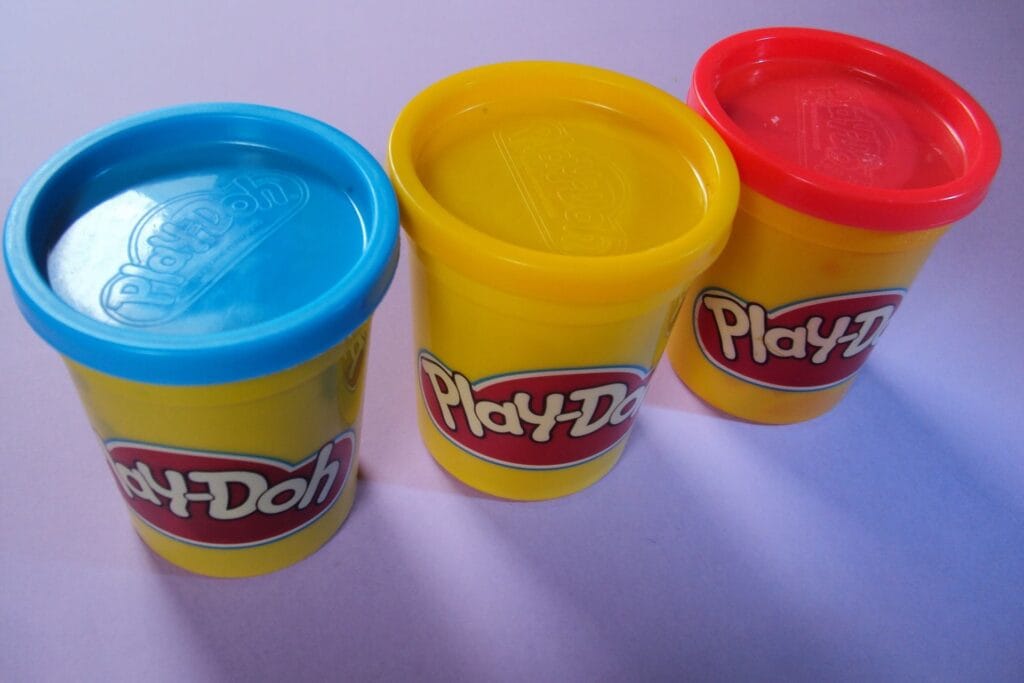
In the last few days it has been published in some media the news that Hasbro, The well-known American toy company has “patented” the smell of plasticine in the United States.
Leaving aside the mistake that many of these media outlets make in describing it as “obvious” which is actually a trademark registration (we recommend reading our Frequently Asked Questions To understand the differences, in this article we raise the question of whether Hasbro could hold an exclusive trademark right over the smell of its plasticine in Spain, given that legislation and practice differ from those in the United States.
Hasbro's scent trademark (registration number 5467089 in the United States Patent and Trademark Office) consists exclusively of the following description: "The mark is a scent of a sweet, slightly musky, vanilla fragrance, with slight overtones of cherry, combined with the smell of a salted, wheat-based dough.”. A rough translation would be: "The brand is a sweet vanilla fragrance, slightly musky, with light hints of cherry, combined with the aroma of a salty wheat-based dough.”.
To assess the viability of Hasbro's hypothetical trademark registration with effect in Spain, we must first analyze which regulations would apply. For a trademark registration to be effective in Spain, the application must either be filed as a national trademark with the Spanish Patent and Trademark Office (OEPM), or register as a European trademark with the European Union Intellectual Property Office (EUIPO). In the first case, the following applies: Law 17/2001, on Trademarks; and, in the second case, the Regulation 2017/1001 on the European trademark. It could also be the case that this application in Spain or the EU originated from an international application through the Madrid Union, However, in any case, one of the two aforementioned rules would apply. Given its relative complexity, we may devote a future article to the international trademark application procedure.
Application for the smell of plasticine as a Spanish trademark (applicable under the Trademark Law):
Article 4 of our Trademark Law is very clear in stating that “A trademark is understood to be any sign capable of being represented graphically that serves to distinguish a company's products or services from those of others in the market.”.
The definition of trademark contained in our national regulations will be subject to modification with the Directive 2015/2436, which eliminates the requirement for graphic representation, but which has not yet been transposed into our legal system. That is to say, Our national regulations currently require that all trademarks applied for in Spain be represented graphically..
For these purposes, the following is of great importance to the subject we are dealing with: judgment of the Court of Justice of the European Union of December 12, 2002 (who plays the Directive 89/104, from which our Trademark Law originates), in the well-known case “Sieckmann”, which responds to the preliminary ruling requested by a German court on the possibility of registering a trademark that Mr. Sieckmann filed with the DPMA (German Patent and Trademark Office) consisting of the smell of a chemical substance, methyl cinnamate. Mr. Sieckmann added:
- The formula of the chemical substance;
- A sample of the smell in a container;
- A description of the smell: “Balsamic-fruity with slight hints of cinnamon”;
- He also indicated that more samples could be obtained by contacting a laboratory whose address he provided in the request.
The Court of Justice of the European Union ruled on the preliminary question, stating that the graphic representation of the trademark should be precise, complete in itself, easily accessible, intelligible, long-lasting y objective; and thus confirmed that these requirements are not met by providing a chemical formula, a sample of the odor, a description of it, or a combination of any of these elements.
In particular, with regard to the chemical formula, the Court considered that it is not sufficiently intelligible, since “Few people would be able to recognize the smell in question in a formula of this type.”. With regard to the deposit of a sample, the Court did not consider it “sufficiently stable and durable”, in addition to “does not constitute a graphic representation”. The description of the smell, meanwhile, “is not sufficiently clear, precise, and objective”.
Thus, in light of Spanish regulations, which require graphic representation of the trademark, a smell is not (at least, not yet) registrable as a trademark., as it seems impossible to represent a smell graphically other than through its chemical formula or description, elements that have already been deemed insufficient by the Court of Justice of the EU to meet this requirement.
Application for the smell of plasticine as a European trademark (European trademark regulations apply):
We have already discussed the relatively recent European trademark regulation. in this post, although we referred at the time to Regulation 2015/2424 and not to the current codified version thereof, No. 2017/1001.
The European Trademark Regulation, as we explained at the time, eliminates the requirement for graphic representation in trademark definition and replaces it with that of “be represented in the European Union Trademark Register in such a way that the competent authorities and the general public can determine the clear and precise scope of the protection granted to its owner.”.
So, does this removal of the requirement for graphic representation in European trademark applications enable the filing of scent trademarks?
Although at first glance it seems that the conclusions may be somewhat more favorable than in the case of Spanish national legislation, the answer is no.
The content of the European Trademark Regulation is supplemented by two other Regulations, the Implementing Regulation 2018/626, and the Delegated Regulation 2018/625. Article 3 of the implementing regulation incorporates almost verbatim the criteria of the Court of Justice in the aforementioned Sieckmann judgment and states: “The mark must be represented in any form deemed appropriate using generally available technology, provided that it can be reproduced in the Register in a clear, precise, complete, easily accessible, intelligible, durable, and objective manner, in such a way that the competent authorities and the general public can clearly and accurately determine the precise subject matter of the protection granted to its owner.”.
Thus, even though the requirement for graphic representation has been removed from the Regulation, if Hasbro were to submit a sample of the smell of its plasticine as a European trademark, it would most likely be rejected for failing to meet the requirement of durability of the representation of the sign in the Register.
Prior to the ruling in the Sieckmann case, the EUIPO had surprisingly accepted a registration for an olfactory trademark, the well-known case of "smell of freshly cut grass” registered to distinguish tennis balls (file no. 428870). This trademark was initially refused by the EUIPO Examination Division in a decision dated June 25, 1998, on the grounds that the description “smell of freshly cut grass” did not meet the graphic representation requirement imposed by the then current Regulation 40/94, on the Community trademark; but The decision was overturned by the EUIPO Board of Appeal in a ruling dated February 11, 1999, and the trademark was granted.. The application expired due to failure to renew in 2006, perhaps because the owner knew that it was a trademark liable to be invalidated in light of the case law of the Court of Justice of the European Union in the Sieckmann case, which already existed at that time. However, the reality is that the trademark application was granted at the time.
Cited as an exceptional (because surprising) case is that of the brand “smell of freshly cut grass”, the truth is that the EUIPO has refused after this (and, especially, following the ruling in the Sieckmann case) several applications for European scent trademarks, among which the following are noteworthy:
- No. 521914, consisting of a matrix of colors that supposedly represented a smell, denied in a decision by the EUIPO Board of Appeal on January 19, 2004.
- No. 1122118, consisting of the description "smell of ripe strawberries” together with the representation of a strawberry, refused in a judgment of the Court of First Instance of the EU of October 27, 2005. In this judgment, the Court specified that “There is no internationally agreed classification of odors. that allows, as in international color codes or musical notation, the objective and precise identification of an olfactory sign by assigning a specific name or code to each smell.”.
- No. 1254861, consisting of the description "the smell of lemon” applied to shoe soles and footwear, denied in a decision by the EUIPO Board of Appeal on December 12, 2005. The appellant, a Spanish company, alleged the prior granting by the EUIPO of the trademark “smell of freshly cut grass”, although without success. The decision, which is published in the file, curiously makes explicit reference to this concession in its last paragraph: “the appeal must be dismissed, notwithstanding the few cases of olfactory marks registered in various national offices of the Member States of the Community or of third countries, or the exceptional case of the olfactory mark registered with the Office prior to the judgment in the Methylcinnamt case. [Sieckmann]“. In other words, it is the EUIPO itself that recognizes the exception in the case of “smell of freshly cut grass” and, if it can be seen that way, your mistake in granting it.
The current situation leaves no room for doubt following the ruling in the Sieckmann case and the adoption of the requirements set out in that ruling by Article 3 of the implementing regulation itself: Olfactory trademarks are not currently accepted under EU (unitary) trademark regulations..
What's more, the EUIPO itself, in its (very useful) Guidelines, explains verbatim (Part B, Section 2, paragraph 9.11.2) that “Olfactory or gustatory marks are not acceptable.” because The current state of technology does not allow for the representation of this type of mark. under the conditions set out in Article 3 of the Implementing Regulation.
In conclusion, Hasbro faces an uphill battle, if not an impossible one, if it wants to extend the trademark protection it has obtained in the United States for the smell of its plasticine to Spain., either as a national trademark or as a European trademark.
In any case, if you have any questions about this matter, you can contact us by email or social media. At Bamboo, we are lawyers specializing in trademarks, and we will be happy to help you!