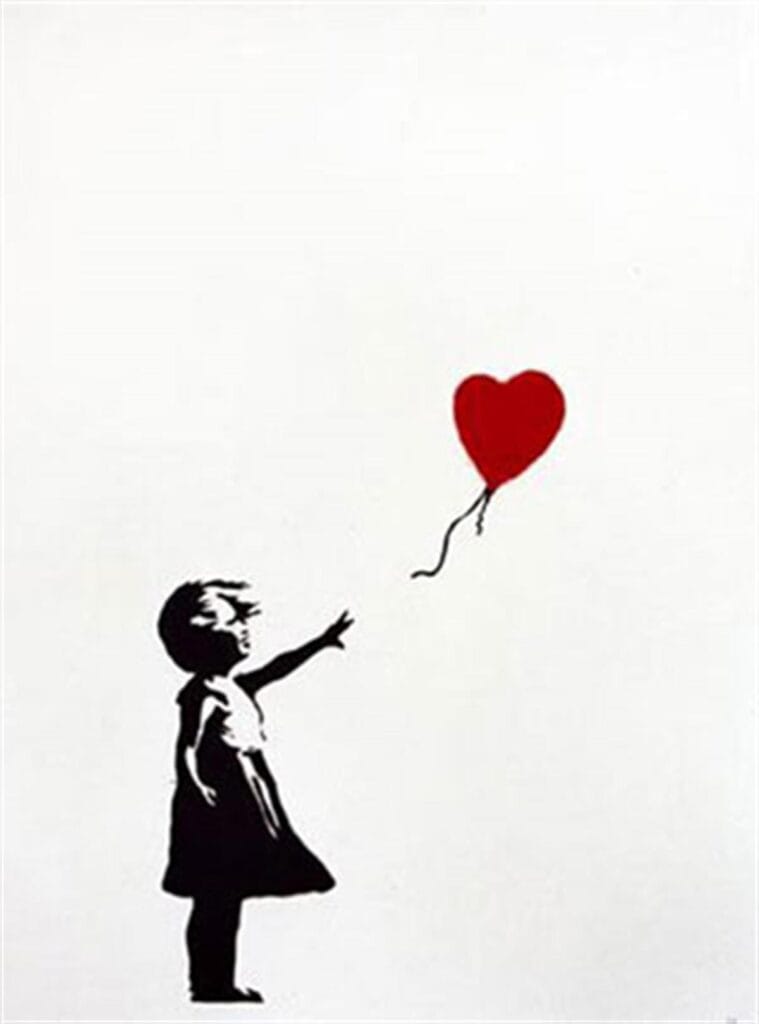
Art lovers and collectors present at Sotheby's auction house in London on Friday, October 5, witnessed an unexpected milestone in art history. After the bidding for the painting Girl with Balloon, a work by the famous, albeit anonymous, street artist known as Banksy, the artwork began to slide through the frame, passing through the shredder that its author had secretly installed beforehand, with the intention of destroying the painting in the event that it was ever auctioned. You can see the result here, in the video that the artist himself posted moments later on his Instagram account.
The video has already gone viral, and newspaper pages have been flooded with reports of the event. But, aside from speculation about the author's true intentions or his possible presence in the “performance,” what does the destruction of a work by its author mean for intellectual property? In this post, we will try to answer this question., on behalf of the Spanish Intellectual Property Law (LPI).
Intellectual property protects, as its name suggests, all original intellectual creations. However, since our Intellectual Property Law does not protect mere ideas, it also requires that such intellectual creations be externalized, materialized in some form. This is the idea underlying the traditional distinction in intellectual property between corpus mysticum and the mechanical body of the work. The corpus mysticum or mystical body refers to the intellectual creation necessary for the existence of a work, thus allowing it to be distinguished from the concept of mechanical body, the mechanical body, the material medium in which the work must necessarily be embodied in order to be protected by our Intellectual Property Law.
The world of plastic arts, the category into which the work that interests us here falls, the painting Girl with Balloon, has certain peculiarities due to the fact that the outsourcing of the work is necessary for its very existence, since it is impossible to separate the corpus mysticum of the mechanical body, the original work on the canvas on which it was first captured. The LPI provides for this circumstance in Article 56, when it states that “the purchaser of the property on which the work has been incorporated shall not, by virtue of this title alone, no exploitation rights about the latter” and, even less so, as is obvious, a moral right. However, in order not to impede the normal distribution of pictorial works and thereby paralyze the functioning of the art market, Article 56 safeguards the right of public exhibition (Article 20.2.h)) of the work in favor of the owner of the medium.
Let us remember at this point that the protection conferred by intellectual property consists of a series of exclusive rights, both of a financial or exploitative nature (reproduction, distribution, public communication, and transformation) and of a highly personal or moral nature, including: the author's ability to modify his work, or his right to withdraw it from the market due to a change in his intellectual or moral convictions, taking into account any rights that third parties may have over it.
Thus, we find ourselves in an exceptional situation, unique in the history of art, where the author of the work himself decides and executes its destruction just minutes after it has been sold, for a considerable sum, incidentally. Is the destruction of the work included among the rights of the author of the work? None of the 203 articles of the LPI expressly recognizes a right of this nature, although we believe that it could be encompassed within one of the rights mentioned above.
As we have seen, Article 14.6 confers a moral right to withdraw the work from the market, with two requirements: that there be a change in the author's intellectual or moral convictions; and that the holder of exploitation rights has been previously compensated. It is well known that Banksy's works protest against capitalism, authority, war... but also against the art world itself, as is perfectly clear in his famous painting I can't believe you idiots actually buy this crap. (as if the destruction of a million-dollar work were not enough of an example). Could the author claim that the auction of his work goes against his moral and/or intellectual convictions? Did he destroy his work in protest, or is it rather a mockery of the excesses of the auction market?
Furthermore, in this case, the owner of the canvas is not necessarily (it would only be the case if they had been expressly transferred, which we dare to say is not the case here) holder of the exploitation rights (only one type of public communication right, that of exhibition), but rather that these remain within the author's sphere of the work. If shredding the work is understood as an exercise of this moral right, it (or what remains of it) would once again belong to Banksy, who in turn would be obliged to compensate the, for now, anonymous buyer for the amount deemed appropriate in this case, both for the right of public display and the auction price of the work, as well as for the corresponding compensation for damages.
However, if we consider the main meaning of the term “withdraw” (to remove, to separate), and the literal and colloquial meaning of the expression “withdrawal from commerce,” we do not believe that the destruction of a work can be understood to fall within the scope of protection of this right.
So, if removal does not include destruction, what other right could fit this scenario? As we mentioned earlier, it could also be Within the moral rights of authors over their works, there is a right to modify them., provided that it is done in accordance with the rights acquired by third parties and the requirements for the protection of cultural assets (Art. 14.5 LPI). The specific method chosen by the enigmatic artist for the self-destruction of the painting does not make it disappear (as if it had been burned, for example): the work does not cease to exist physically, but rather there has been a modification in the medium that contained it and, with it, in the form in which it was expressed. Considering that experts in the art world are already talking about a revaluation of the shredded painting of at least 50% of its initial value, it seems clear that passing the canvas through the shredder hidden in the frame actually produces a modification in its form, resulting in a new, albeit unconventional, work. The subsumption of this very particular case tol The aforementioned precept is not so straightforward., as it requires that the modifications made by the author respect the rights acquired by third parties in order to be applicable., without specifying what type of rights he is referring to: ordinary property rights, rights of possession over the medium of the work? Economic exploitation rights? Independently of those of the owner of the medium or not? Be that as it may, it does not appear that Banksy took into account the opinions, preferences, and much less the rights of third parties of any kind in this vandalistic modification.
On the other hand, Article 21 of the LPI does not actually define what the right of transformation is and what it is not, but merely lists some of its forms, including “any other modification in its form that results in a different work”. In our opinion, if the destruction of Girl with Balloon In terms of intellectual property, this is a modification., would then be protected by two different types of rights, but, at least in this case, with identical material consequences: the moral right, which is therefore inalienable and imprescriptible, to modify their work; and the economic right, of which they are the legitimate owner provided that it has not been transferred to a third party..
The truth is that our legislation had not anticipated such an exceptional situation as the one that occurred; it does not contemplate the possibility of the owner of the exploitation rights carrying out a transformation on a work that physically belongs to a third party, without their consent. Under Article 21, the intellectual property rights will continue to belong to Banksy as the material (and intellectual) author of the transformation, but what happens now with the medium? Nor is there any provision for possible compensation. Does this mean that, under Spanish intellectual property law, Banksy is free to destroy/transform his work after it has been purchased for millions?
According to Sotheby's, discussions are still ongoing with the buyer to try to clarify the fate of the work, discussions that will have to include the street artist at some point, as there are many questions to be answered in terms of intellectual property. The material owner of the work and its intellectual author are irrevocably linked by intellectual property rights: the best possible scenario for the buyer (always from the perspective of Spanish intellectual property law) would be for Banksy to decide to transfer all exploitation rights for the “new work,” the result of the transformation of Girl with Balloon, thus becoming the sole owner of the painting, in terms of both ordinary and intellectual property. A situation that, modestly speaking, we very much doubt will occur.
[Article written by Patricia Fernández Céspedes]