From a legal standpoint, a sign constitutes a trademark when it serves to distinguish a company's products or services from those of others in the market. This distinctive or differentiating capacity is fundamental to the sign: if it is not sufficiently capable of indicating a business origin to the consumer, it cannot receive protection under our trademark regulations.
However, although it is not common, such a sign does not necessarily have to be a name, a logo, or an isotype. Our legislation (both national and European – Law 17/2001, on Trademarks, y Regulation 2017/1001 on the European Union trademark, in accordance with the current codified version) allows said sign to be, for example, a three-dimensional shape, a sound, or a color (We already discussed color marks in this article). In this post, we will talk about the sounds as marks.
We must first consider that consumers are normally accustomed to products and services on the market being distinguished by a sign considered “traditional” (a word, a combination of words, an image, etc.). It is difficult for any company, not legally, but commercially, for a simple sound to evoke a business origin.. Consider the marketing, advertising, and market establishment work that must be done (certainly over many years) for users to identify our product or service with a simple sound. Thus, it is practically impossible for a sound to be distinctive (in terms of branding) on its own, and it is normally necessary for it to have acquired what is known as supervening distinctiveness (that is, distinctiveness acquired over time through use in economic transactions).
Thus, very few companies, at least in Europe, have managed to obtain trademark status for any of the sounds used in their products or services. It is not particularly surprising to note that, of the more than one million trademarks registered in the European Union in the European Union Intellectual Property Office (EUIPO), there are only 193 registered sound marks (around one 0,018% of the total).

*Source: TMView
In our country, in the Spanish Patent and Trademark Office (OEPM), only appear 20 registered sound marks, which demonstrates the difficulty of obtaining protection for a sound in this way.
What are these brands? Well, of the few that exist, some of them are well known, or even renowned, precisely because of the necessary prior establishment in the market that they have had to develop. It is strange, however, that not all of them are. In Spain (registered with the OEPM), the following are noteworthy:
- File No. 3532668 “MERCADONA MERCADONA MERCADONA MERCADONA,” owned by Mercadona, Inc.
- File No. 2936023 “FONTANEDA COOKIES ARE SO GOOD,” owned by Kraft Foods Spain Intellectual Property, LLC.
- File No. 2989520 “TWENTY-ONE TWENTY-TWO” (yes, with the spelling mistakes...), owned by Center for Culture and Knowledge, Inc.
If you wish to search for these trademarks, you can enter the file numbers at this search engine of the SPTO.
At the level of the European Union, As trademarks registered with the EUIPO, we can highlight the following:
- File No. 11051951, owned by Apple, Inc. The file can be consulted. here.
- File No. 5868261, owned by Microsoft Corporation. The file can be consulted. here.
- File No. 5170113, owned by Metro-Goldwyn-Mayer Lion Corporation. The file can be consulted. here.
- File No. 3661907, owned by McDonald's International Property Company, Ltd. The file can be consulted. here.
- File No. 1040955, owned by Nokia Corporation. The file can be consulted. here.
- File No. 5090055 (the famous Tarzan yell), owned by Edgar Rice Burroughs, Inc. The file can be consulted. here.
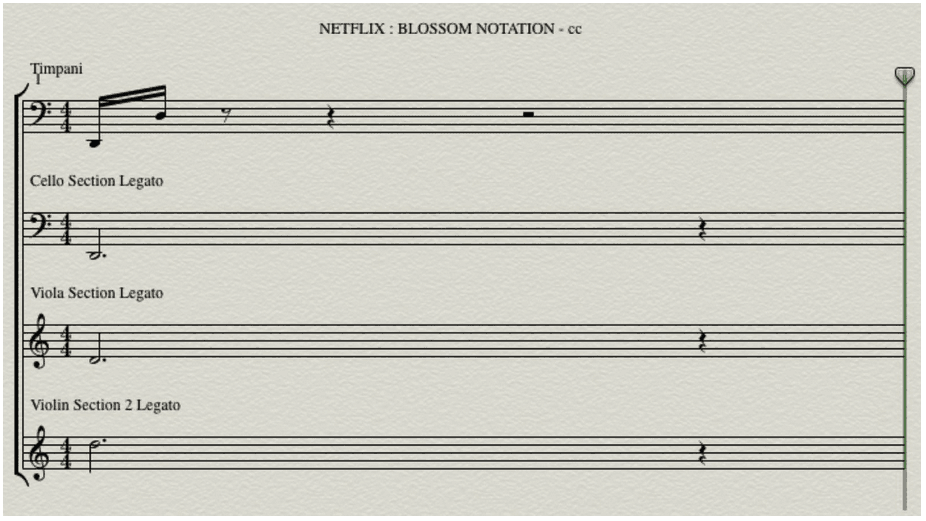
- File No. 15875024, owned by Netflix, Inc. (requested, not yet granted). The file can be consulted. here.
We already explained in a previous post that as of October 1, 2017, all the provisions of Regulation 2015/2424 became fully applicable, leading to the current codified version of EU Trademark Regulation 2017/1001, cited above. Well, The requirement to graphically represent the musical score or notes of sound marks before the EUIPO has been removed., simply providing a sound file in .mp3 format. That is the case with this, this o this other one application to the EUIPO, which no longer includes a graphic representation.
The issue of sound marks also opens up the debate on convergence between intellectual property protection (as a phonographic work) and industrial property protection (as a sound trademark) of those sounds that are sufficiently distinctive to constitute a trademark which, due to their originality, may also constitute a work within the meaning of the Consolidated Text of the Intellectual Property Law; a particularly interesting debate regarding the duration of rights (70 years post mortem in the case of intellectual property, compared to a potentially unlimited duration, as long as there is no expiration, in the case of trademarks), to which we may devote a specific post in the future.